
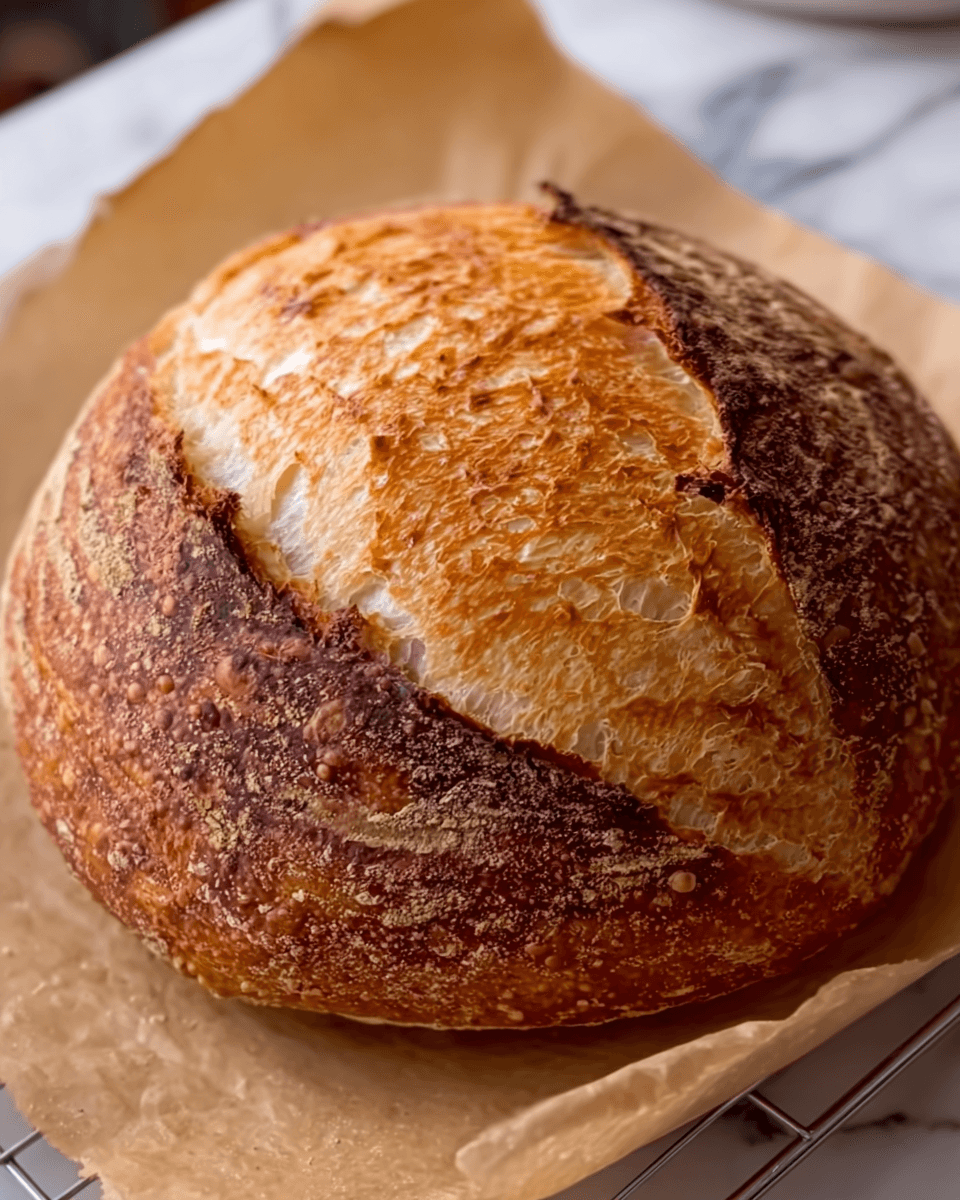
This sourdough bread recipe makes a crackling, golden loaf — built from just flour, water, salt, and a bubbly starter, baked at 450F in a Dutch oven until the crust shatters when you press it. I baked my first loaf on a rainy Sunday about three years ago, mostly out of curiosity, and my husband ate half of it before it even cooled down. Since then it has become our weekend ritual — I feed the starter Friday night, mix the dough Saturday morning, and we pull warm bread out of the oven by Sunday breakfast. Unlike most sourdough recipes that call for a separate autolyse step, this one mixes everything together from the start, which cuts the fuss. I have tested this at least 30 times now and the method works in warm kitchens and cool ones. It is crusty, tangy, and deeply satisfying to make from scratch.
Why You Will Love This Sourdough Bread Recipe
This sourdough bread recipe works because it keeps everything simple — four ingredients, about 30 minutes of hands-on work, and a timeline that fits around a normal weekend.
- Only 4 ingredients — Flour, water, salt, and starter. No commercial yeast, no sugar, no oil. That is the entire grocery list.
- 30 minutes of real work — The total timeline is 18 to 19 hours, but you are only touching the dough for about half an hour. The rest is waiting.
- Crackling crust every time — Baking in a Dutch oven traps steam, which gives you that blistered, shatteringly crispy crust you see at bakeries. I have never gotten this result any other way.
- Cold proof for deeper flavor — A 24-hour refrigerator proof builds a tangy, complex flavor that a short proof cannot match.
- Freezer-friendly — Bake two loaves, freeze one. It keeps for 2 to 3 months wrapped tightly, and reheats like it just came out of the oven.
Ingredients Overview
You need four ingredients and every one of them matters. Good bread flour and an active starter are the two that will make or break your loaf. I always weigh everything on a kitchen scale — cups are too inconsistent for bread baking.
- 50 to 100g (1/4 to 1/2 cup) bubbly, active sourdough starter — I always use 100g
- 375g (1 1/2 cups plus 1 tablespoon) warm water
- 500g (4 cups plus 2 tablespoons) bread flour
- 9 to 12g (1 1/2 to 2 1/2 teaspoons) fine sea salt
The starter should be fed 4 to 8 hours before mixing and pass the float test — drop a small spoonful in water, and if it floats, it is ready. I usually go with about 10g of salt.
Directions
This sourdough bread recipe follows a simple rhythm: mix, fold, wait, shape, proof, bake. Most of the time is passive, so you can go about your day while the dough does its thing.
- Whisk the starter and warm water together in a large bowl with a fork until the starter is mostly dissolved. Add the bread flour and salt. Stir until no dry patches remain, finishing by hand to form a rough, shaggy dough. Cover with a damp towel and rest 30 minutes.
- After the rest, grab one side of the dough, stretch it up, and fold it into the center. Rotate the bowl and repeat 4 to 5 times. Cover and rest 30 minutes, then repeat. If you have the time, do 4 sets total over 2 hours. Even one set helps — do not stress if you can only manage one or two.
- Cover the bowl with an airtight lid so the dough does not dry out. Let it rise at room temperature for about 8 to 10 hours at 70F (21C). In a warmer kitchen around 78F, it may finish in 6 hours. The dough is ready when it has grown by 50 to 75 percent, has bubbles on the surface, and jiggles when you shimmy the bowl. A straight-sided container makes tracking the rise much easier than a curved bowl.
- Turn the dough onto a lightly floured surface. Fold the top down to the center, rotate slightly, fold again, and repeat until you come full circle. Use a bench scraper to drag the dough toward you and build surface tension. Let it rest seam-side up for 30 minutes. Line an 8-inch bowl or banneton with a flour sack towel and dust generously with rice flour — rice flour will not burn the way all-purpose does. Shape the dough a second time, then place it seam-side up in the basket.
- Cover the basket and refrigerate. You can proof for as little as 1 hour or as long as 48 hours. I have found that 24 hours gives the best crumb and the deepest tangy flavor. For proofs longer than a few hours, tuck the basket into a loosely tied produce bag to prevent the surface from drying out.
- Place a Dutch oven with the lid on into the oven and preheat to 550F (290C) for at least 30 minutes. Cut parchment to fit the pot. Place the parchment over the basket and flip to release the dough. Score the top with a razor blade or sharp knife — a simple X works well. Use the parchment to lower the dough into the pot. Drop the oven to 450F (230C), cover, and bake 30 minutes. Remove the lid, lower to 400F (200C), and bake 10 to 15 minutes more until the crust is deep golden brown and the loaf sounds hollow when you thump the bottom. For extra crisp, set the loaf directly on the oven rack for the last 5 to 10 minutes. Cool on a wire rack at least 1 hour before slicing.
Storage and Reheating
Sourdough stores better than most homemade bread because the natural acidity slows mold growth. Store the loaf at room temperature in an airtight plastic bag or container for up to 3 days — that comes straight from the original recipe. For the fridge, wrap tightly and store 3 to 4 days per USDA food safety guidelines.
To freeze, let the loaf cool completely, wrap in plastic wrap then aluminum foil, and freeze for 2 to 3 months. I slice before freezing and separate slices with parchment so I can grab exactly what I need.
To reheat a whole or half loaf, splash a few drops of water on the crust and bake at 375F for 10 to 15 minutes. For single slices, a toaster or hot cast-iron skillet works best — about 2 minutes per side until warm and crispy.
Frequently Asked Questions
How long does sourdough bread last in the fridge?
Store in an airtight container in the refrigerator for 3 to 4 days per USDA food safety guidelines. This bread also freezes well — wrap tightly in plastic and foil and freeze for 2 to 3 months with no loss in quality. Reheat at 375F for 10 to 15 minutes until the crust crisps back up.
Can I substitute bread flour in this sourdough bread recipe?
In my experience, all-purpose flour works but gives a softer, less chewy crumb because it has lower protein (10 to 11 percent vs 12 to 14 percent). A 50-50 blend of bread and all-purpose flour is a good middle ground. Whole wheat works for up to 20 percent of the total — more makes the loaf dense.
How do I know when sourdough bread is done baking?
The loaf is done when the crust is deep golden brown — the color of dark honey, not pale or blonde. Thump the bottom and listen for a hollow sound. If it sounds dense, set the loaf directly on the oven rack at 400F for another 5 to 10 minutes.
What goes well with sourdough bread?
In my experience, sourdough pairs best with tomato soup for dunking, scrambled eggs and chives for breakfast, a hearty beef stew where the bread soaks up the broth, and a cheese board with sharp cheddar and fig jam. It also makes a great base for avocado toast.
Is sourdough bread gluten-free?
No. This recipe uses 500g of bread flour, which contains gluten. The long fermentation does break down some gluten proteins, which may make it easier to digest for people with mild sensitivity, but it is not safe for anyone with celiac disease. There is no direct gluten-free swap for this recipe.
Final Thoughts
This sourdough bread recipe is the kind of weekend project that gets better every single time you bake it. You will learn your starter’s rhythm, figure out what jiggly and airy actually looks like in your kitchen, and dial in the bake until the crust is exactly how you want it. There is nothing in any store that comes close to a loaf you pulled from your own oven — crackling crust, tangy crumb, and a smell that turns your whole house into a bakery. Give this sourdough bread recipe a try this weekend and drop a comment below — I want to hear how your loaf turned out.
Explore More Flavors to Savor
- Billion Dollar Buttery Biscuits — These flaky, tender biscuits are the perfect rich accompaniment to any meal or a delightful treat on their own.
- Honey Butter Sweet Alabama Pecan Bread — Indulge in this sweet, nutty bread, perfect for breakfast or a comforting afternoon snack.
- Cloud Bread — Light as air and incredibly versatile, this unique bread offers a soft texture for sandwiches or a low-carb option.
- Greek Yogurt Almond Flour Bread — Soft, No-Carb & Easy — Enjoy a soft, satisfying bread alternative that’s low in carbs and surprisingly easy to make.
- Philly Cheesesteak Stuffed Cheesy Breadsticks — Combine two favorites into one irresistible snack or appetizer with these savory, cheesy breadsticks.
- Potsticker soup with mushrooms & bok choy – 25 min, serves 4 — This quick and flavorful soup is a warming meal that pairs wonderfully with a slice of crusty bread.
Sourdough Bread Recipe
- Total Time: 18 hours 45 minutes
- Yield: 1 loaf (12 slices) 1x
Description
A classic sourdough bread recipe with a crackling crust and soft, tangy crumb — made with just 4 ingredients and a hot Dutch oven. About 30 minutes of hands-on work and 18 hours of passive rising. No commercial yeast, no sugar, no oil.
Ingredients
- 50 to 100g (1/4 to 1/2 cup) bubbly, active sourdough starter — I always use 100g
- 375g (1 1/2 cups plus 1 tablespoon) warm water
- 500g (4 cups plus 2 tablespoons) bread flour
- 9 to 12g (1 1/2 to 2 1/2 teaspoons) fine sea salt
Instructions
- Mix the dough: Whisk starter and warm water together in a large bowl with a fork until the starter is mostly dissolved. Add bread flour and salt. Stir until no dry spots remain, finishing by hand to form a rough dough. Cover with a damp towel and rest 30 minutes.
- Stretch and fold: Grab one side of the dough, pull up and fold into the center. Rotate and repeat 4 to 5 times. Rest 30 minutes and repeat. Do up to 4 sets total over 2 hours. Even one set helps.
- Bulk ferment: Cover the bowl with an airtight lid. Let rise at room temperature for about 8 to 10 hours at 70F (21C). In a warmer kitchen around 78F, it may take only 6 hours. The dough is ready when it has increased 50 to 75 percent in volume, has surface bubbles, and jiggles when you move the bowl.
- Shape: Turn dough onto a lightly floured surface. Fold the top down to center, rotate, and repeat until you come full circle. Use a bench scraper to build surface tension. Rest seam-side up 30 minutes. Line an 8-inch bowl or banneton with a flour sack towel dusted with rice flour. Shape again, then place seam-side up in the basket.
- Cold proof: Cover and refrigerate 1 to 48 hours. 24 hours is recommended for deepest flavor and best crumb. For longer proofs, tuck into a loosely tied produce bag to prevent drying.
- Score and bake: Preheat oven to 550F (290C) with Dutch oven inside for at least 30 minutes. Place parchment over the basket and invert to release dough. Score the top. Lower dough into the pot on the parchment. Reduce oven to 450F (230C), cover, and bake 30 minutes. Remove lid, reduce to 400F (200C), and bake 10 to 15 minutes more until deep golden brown. Optionally bake on the oven rack the last 5 to 10 minutes. Cool on a wire rack at least 1 hour before slicing.
Notes
Store at room temperature in an airtight bag or container for up to 3 days, or refrigerate 3 to 4 days per USDA guidelines. To freeze, wrap cooled loaf in plastic wrap and foil and freeze for 2 to 3 months. Reheat a whole loaf at 375F for 10 to 15 minutes after splashing water on the crust. Individual slices reheat best in a toaster or on a cast-iron skillet. Use the float test before mixing — if a spoonful of starter floats in water, it is ready.
- Prep Time: 30 minutes
- Cook Time: 45 minutes
- Category: Bread
- Method: Baking
- Cuisine: American
Nutrition
- Serving Size: 1 slice
- Calories: 165
- Sodium: 325mg
- Fat: 1g
- Carbohydrates: 33g
- Fiber: 1g
- Protein: 5g